
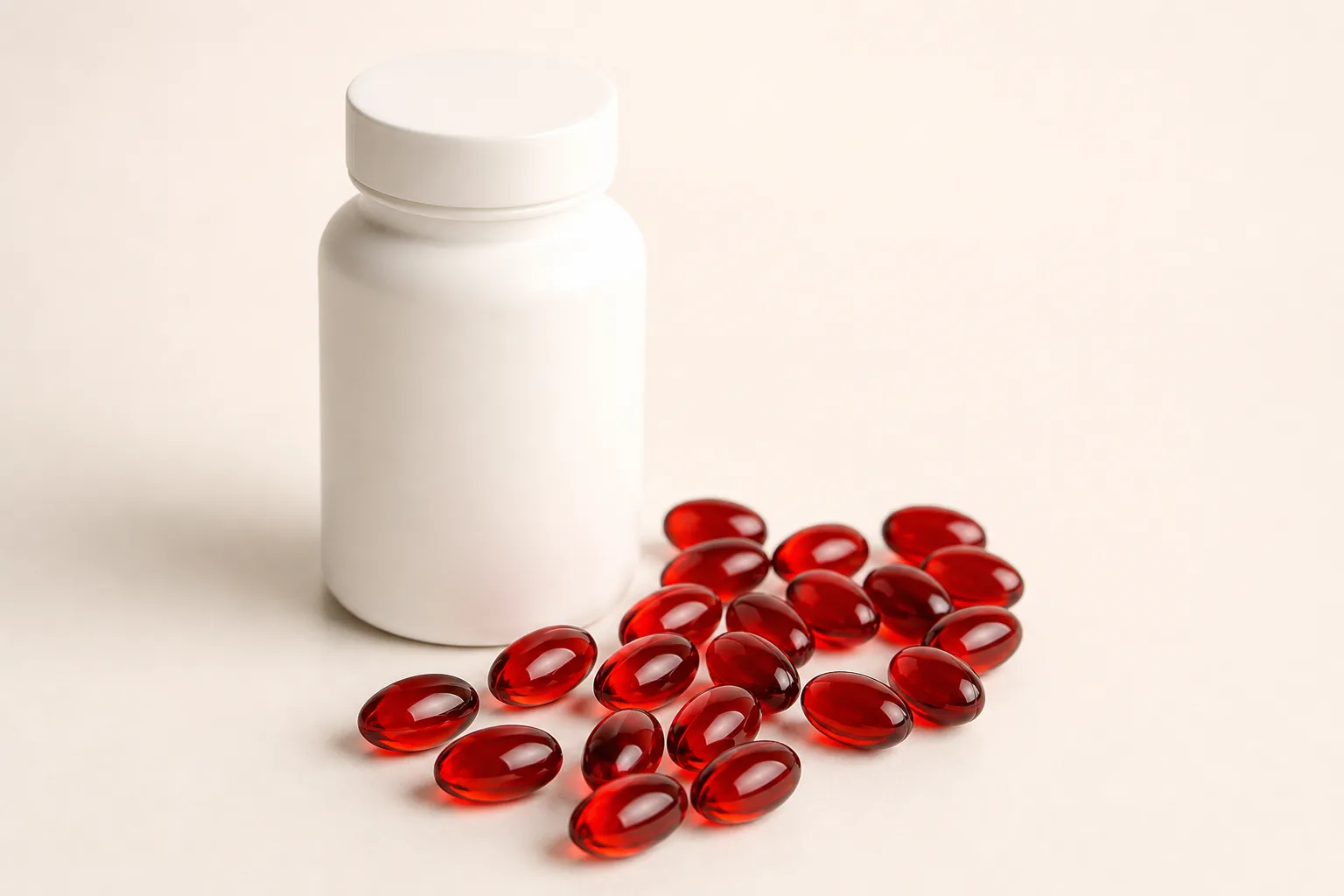
Lutein and zeaxanthin are two of the most consistently requested carotenoids in the eye-health segment, and softgels are the format most buyers ask for. What follows is what actually goes into a commercial lutein softgel line — the formulation decisions that move cost, stability and shelf life, and the labelling questions worth settling before artwork is signed off.
Why this ingredient pair stays in demand
Lutein and zeaxanthin are xanthophyll carotenoids that the human body does not synthesise, so they have to come from the diet or from supplementation. That single fact is why the category behaves like a staple rather than a trend: demand does not depend on a fashion cycle. Private-label listings for lutein and zeaxanthin softgels number in the hundreds on Alibaba.com, a large share of them from Verified manufacturers, and the format is dominated by oil-filled softgels rather than tablets or two-piece capsules.
For a brand, the appeal is practical. The ingredient pair is well understood by buyers, the finished product is easy to position, and the softgel lets you deliver a compact, easy-to-swallow serving at a sensible unit cost.
Free lutein or lutein esters: the first decision
Lutein is supplied commercially in two forms, and the choice drives your label, your dose and your cost.
- Free lutein — the form found in leafy greens, typically standardised to 5–20% by HPLC. Often the preferred option for premium-positioned brands.
- Lutein esters — esterified with fatty acids and usually supplied as an oil suspension or beadlet. Generally more stable in storage and cheaper per unit of lutein, but labelled differently and requiring a conversion step in the body.
Zeaxanthin is normally dosed well below lutein — a 5:1 ratio is a common starting point — and is available as free zeaxanthin or as the ester. Whichever route you take, treat the ratio as a deliberate commercial decision rather than a default.
The oil base is not a detail
Carotenoids are fat-soluble and absorb poorly from a dry matrix. A softgel solves that by presenting the actives already dispersed in lipid, and the carrier you pick also shapes how the capsule looks on shelf.
- Sunflower or safflower oil — the neutral, vegan-friendly default; keeps the fill pale and lets the carotenoid colour lead.
- MCT oil — low viscosity, friendly to fast filling lines, clean label.
- Olive oil — a strong marketing story, though it can shift the fill colour.
- Fish or algal oil — used when lutein is combined with omega-3 in one softgel.
Serving design
Typical commercial servings run between 10 mg and 40 mg of lutein, often paired with 1–4 mg of zeaxanthin. Because softgel size is set by fill volume, the practical constraint is total oil weight per capsule — commonly 500–1,000 mg. Depending on the ingredient form and the oil load, the finished softgel is usually a small-to-medium oval.
Stability, light protection and QC
Carotenoids are sensitive to light, heat and oxygen. Three controls matter most on the line: an opaque or amber shell to limit light transmission, nitrogen flushing during filling, and a well-sealed shell that keeps oxygen out for the product's shelf life. Every batch should ship with a certificate of analysis covering identity, assay and microbiological limits, and the finished product should be made in an FDA-registered, GMP-compliant facility.
Labelling and market positioning
What you may print depends on the destination market. In the United States, structure/function wording is permitted with the standard disclaimer. In the European Union, only authorised health claims may be used. In several Asian markets the product may be regulated as a food or a health food rather than as a supplement. Decide label copy alongside the formula — retrofitting claims after artwork approval is expensive.
How Haiyue Shengda works
Our softgel line runs lutein and zeaxanthin fills in gelatin or vegetarian shells, with custom colour, dose and packaging under your own brand, and OEM/ODM customization supported. MOQ starts from 100 units per SKU for trial batches, free samples arrive in 3–5 days, and shipment happens within 7 days with a COA for every batch. See our softgel capabilities or contact us — we respond within one hour.