
Packaging is usually the last thing a new supplement brand decides and the first thing its customer touches. It also drives more of your cost, your shelf life and your minimum order quantity than most buyers expect. Here is how the main formats compare, and what actually decides between them.
Packaging and dosage form are decided together
It is tempting to choose a dosage form first and shop for packaging afterwards. In practice the two constrain each other. A powder needs headspace and a wide mouth; a softgel needs a barrier against light and oxygen; an effervescent tablet needs a moisture-proof tube because it will react with ambient humidity. Deciding them in the same conversation saves a redesign later.
The primary packaging formats
- Bottles — the default for capsules, tablets and softgels. HDPE with a screw cap, or PET when you want the contents visible. Count-based fills are simple, and the format is accepted by almost every market.
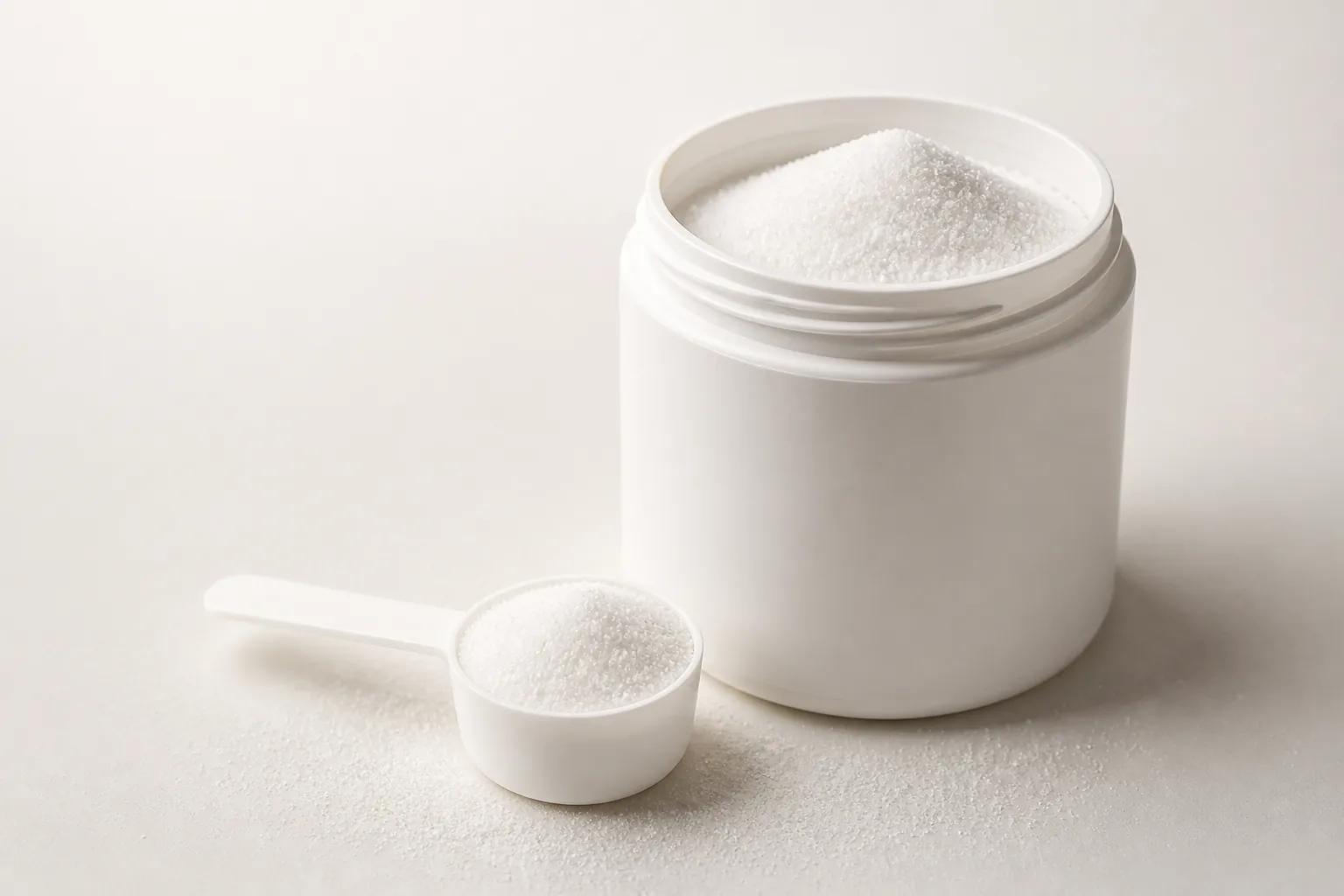
- Tubs and jars — the standard for powders. Typical sizes run from 200 g to 1 kg, so the tub has to be sized to the finished weight and the scoop, not just the volume of powder.
- Blister packs — unit-dose presentation for tablets and softgels. Strong tamper evidence and a premium look, but the tooling is per-shape, which is what pushes the minimum order up.
- Stick packs and sachets — single-serve doses for powders and instant drinks. Excellent portion control and easy sampling, at a higher cost per gram than a bulk tub.
- Ampoules and vials — for liquid shots and drops. Glass gives the best barrier; the trade-off is weight, breakage risk in transit and higher freight cost.
- Pouches — flexible, light and cheap to ship. Barrier films can be specified, but a pouch reads as less premium than a tub at the same price point.
Barrier properties and shelf life
How long a product stays good depends on what the packaging keeps out. Three factors do most of the work:
- Oxygen — the main threat to oils and carotenoids. Sealed softgel shells, nitrogen flushing and an opaque outer wall all limit it.
- Moisture — the main threat to powders and effervescents. Desiccant sachets and a tight seal matter more than the outer material.
- Light — the main threat to coloured actives. Amber glass, opaque HDPE or a fully covered carton solve it.
Shelf life is normally supported by real-time and accelerated stability data rather than assumed. If you are launching in a warm or humid market, that testing should be planned before artwork is finalised.
Labels: what can be printed where
Label requirements differ by destination market. In the United States, a supplement label needs the statement of identity, net quantity, ingredient list with amounts, and the standard disclaimer for structure/function claims. In the European Union, authorised health claims govern the wording and a nutrition declaration is required. Several Asian markets regulate the same product as a food or a health food, with their own registration route.
Two practical consequences follow. First, decide the market before the artwork, not after. Second, keep the mandatory panel in a fixed block so a single label layout can be adapted across markets instead of being redrawn each time.
Why packaging moves your MOQ
Formulation MOQ and packaging MOQ are different numbers, and the larger one wins. Filling 100 units of powder is straightforward; ordering 100 printed tubs is not, because printing runs are set up per design. Blister tooling and custom-shaped bottles behave the same way. If your goal is a genuine trial batch, standard containers with printed labels usually cost far less to start than custom-moulded or blister formats — you can move to custom primary packaging once the product proves itself.
How Haiyue Shengda works
We fill tubs, bottles, stick packs and sachets across capsules, tablets, softgels, gummies, powders and oral liquids, with custom flavour, fill weight and label design under your own brand, and OEM/ODM customization supported. MOQ starts from 100 units per SKU for trial batches, free samples arrive in 3–5 days, and shipment happens within 7 days with a COA for every batch. See our sports nutrition line or contact us — we respond within one hour.